



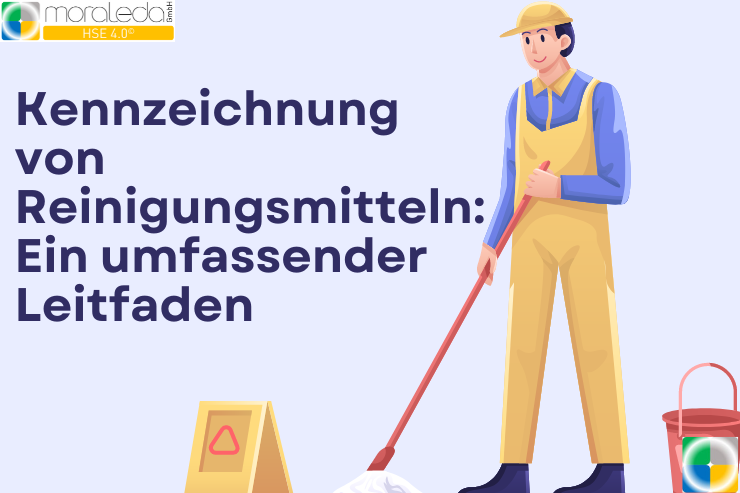
Cleaning products can be found in almost every household and business. They contribute to cleanliness and hygiene, but also pose potential dangers. Correct labeling of cleaning products is therefore essential to provide both consumers and workers with important information on safe use and handling. This article covers the most important aspects of cleaning product labeling.
Table of contents
1. Legal basis
The Labeling of cleaning productsin Germany is subject to various legal regulations, in particular Regulation (EC) No. 1272/2008 (CLP Regulation) and the Detergents Regulation (EC) No. 648/2004. These regulations are intended to ensure that cleaning products can be used and handled safely. They determine what information must be provided on cleaning product packaging in order to minimize risks and provide users with all the necessary information.
2. Important labeling elements
The most important labeling elements that must be present on cleaning product packaging are:
- Product name and manufacturer information:The name of the cleaning product and the contact details of the manufacturer, importer or distributor must be clearly visible.
- Hazard pictograms:Cleaning products that contain dangerous chemicals must be marked with appropriate hazard pictograms. These pictograms provide information about the specific hazards that may arise from the product, such as corrosive, flammable or environmentally hazardous properties.
- Signal words:The CLP regulation requires the use of signal words such as “danger” or “caution” to convey the severity of the hazards.
- Hazard warnings (H-phrases):These instructions describe the specific dangers posed by the product. For example, an H-statement may indicate that the product may cause skin irritation.
- Safety instructions (P-phrases):These instructions provide recommendations for safe handling of the product, e.g. “Keep out of the reach of children” or “Wear protective gloves”.
- Ingredients:The detergent regulations require the ingredients to be stated, especially those that can trigger allergic reactions. This information can often be found on a separate website, which is indicated on the packaging.
3. Meaning of labeling
Cleaning product labeling plays a critical role in protecting consumer health and safety. It allows users to use the products correctly and safely and minimizes the risk of accidents and damage to health. Clear and understandable labeling is of utmost importance, especially in the home, where cleaning products often come into contact with children and pets.
4. Labeling for commercial use
In the commercial sector, especially in industry and healthcare, the labeling of cleaning products is also of central importance. Stronger and specialized cleaning products are often used here, which can be potentially more dangerous. Compliance with labeling regulations helps employers protect their employees from the dangers of chemical substances and meet statutory occupational health and safety regulations.
5. Labeling challenges
One of the biggest challenges when labeling cleaning products is communicating complex information clearly and understandably. The labeling must be designed in such a way that it can be easily understood by all users, regardless of their level of education or knowledge. This requires careful selection of symbols, colors and text to make the information as intuitive and accessible as possible.
6. Examples of labeling elements
To clarify the meaning and application of the labeling elements, some examples are listed here:
- Hazard pictograms:A symbol with a flame indicates a flammable substance, while a symbol with a skull and crossbones indicates a toxic substance.
- H-phrases:“H315: Causes skin irritation” informs the user that the product may cause irritation if it comes into contact with the skin.
- P-phrases:“P102: Keep out of reach of children” provides an important safety recommendation to avoid accidents.
7. Innovations and the future of labeling
The development of new technologies and materials also leads to innovations in the labeling of cleaning products. For example, QR codes could be integrated on the packaging, giving users access to more detailed information and application videos. The use of multilingual labels could also help to further improve the understandability and accessibility of the information.
8. Tips for consumers
It is important for consumers to pay attention to labeling when purchasing and using cleaning products. Here are some tips:
- Read the labels carefully and observe all hazard and safety warnings.
- Use the products only according to the manufacturer's instructions.
- Keep cleaning products out of the reach of children and pets.
- Use appropriate protective measures such as gloves or goggles when recommended.
- Research the eco-friendly alternatives and, if possible, choose products with a lower environmental impact.
Conclusion
The labeling of cleaning products is an important aspect of consumer protection and occupational safety. It provides users with the necessary information to use the products safely and effectively. By complying with regulatory requirements and continually improving labeling, manufacturers can help ensure the safety and well-being of consumers and workers. Innovations and new technologies offer exciting opportunities to further improve the comprehensibility and accessibility of information.